Waipahu Electrical Repair
When a breaker drops every time the family cooks, or an outlet feels warm under your hand, we find where the fault starts and repair it there.
Dinnertime Is When Houses Complain
Ask a Waipahu family when the breaker trips and the answer usually comes back the same: around dinner. The rice cooker is on, somebody is warming a plate in the microwave, the second fridge is cycling, and the AC in the back bedroom just kicked in. In a house where extended family lives under one roof, that is an ordinary weeknight, and it is the exact moment a tired circuit gives up.
A breaker that trips under that load is working. The mistake is swapping in a larger breaker so it stops, because the breaker exists to protect the wire, and a bigger one lets that wire run hot inside the wall. What we do instead is find out what shares the circuit. In older houses a single breaker often feeds half the kitchen and a bedroom besides, and moving one heavy appliance to its own circuit ends the trips.
Warm and dead outlets get a closer look than people expect. A receptacle that feels warm, shows brown or black marks around a slot, or went dead after a burning smell is a connection failing inside the box. Sometimes it is a worn device that has carried a heavy appliance for years. Sometimes the wire behind it has overheated and needs to be cut back to clean copper. Either way it should not stay in use while you wait.
Single-wall houses bring a problem of their own. With little or no wall cavity, wiring in many older Waipahu homes already runs on the surface, and over the decades families have filled the gaps with extension cords: across a doorway, along a baseboard, from one room into the next. Those cords get pinched under furniture and overloaded behind the television. Part of a repair visit here is often trading a workaround for a real receptacle on a proper circuit.
Flickering sorts into two kinds. One light that flickers usually means a loose connection at the fixture, the switch or a splice nearby. Lights in several rooms that brighten and dim together are more serious, because that pattern can come from a loose neutral putting uneven voltage on everything plugged in. The second kind deserves a visit soon, not someday.
The surface wiring itself deserves a look while we are there. In a single-wall house the original runs have been out in the open for a very long time, and open wiring ages in ways hidden wiring does not. Clips work loose, insulation gets brittle where the afternoon sun reaches through a window or a carport, and somewhere along the way somebody tapped a new outlet off the nearest run without asking what else it fed. None of that shows up as a single dramatic failure. It shows up as a house where small problems keep appearing in new places, and we would rather find the pattern than chase each one.
Before we arrive, a few notes help more than you would think. Which breaker trips, what was running when it did, and whether it has gotten more frequent. If an outlet smelled hot or looked scorched, leave it unplugged and tell us which room.
Some calls end with a repair and some end with a harder conversation. If the trouble follows the whole house rather than one circuit, or the main breaker is the one letting go, the service may simply be too small for the household, and the honest next step is a panel upgrade. We would rather say so on the first visit than come back for the same breaker three times.
Recent work is in our gallery. Or tell us what the house is doing and when, and a licensed electrician will call you back.

Inside a Repair Visit
The first part of the visit goes to finding the cause. Then we fix what the cause calls for and nothing it does not.
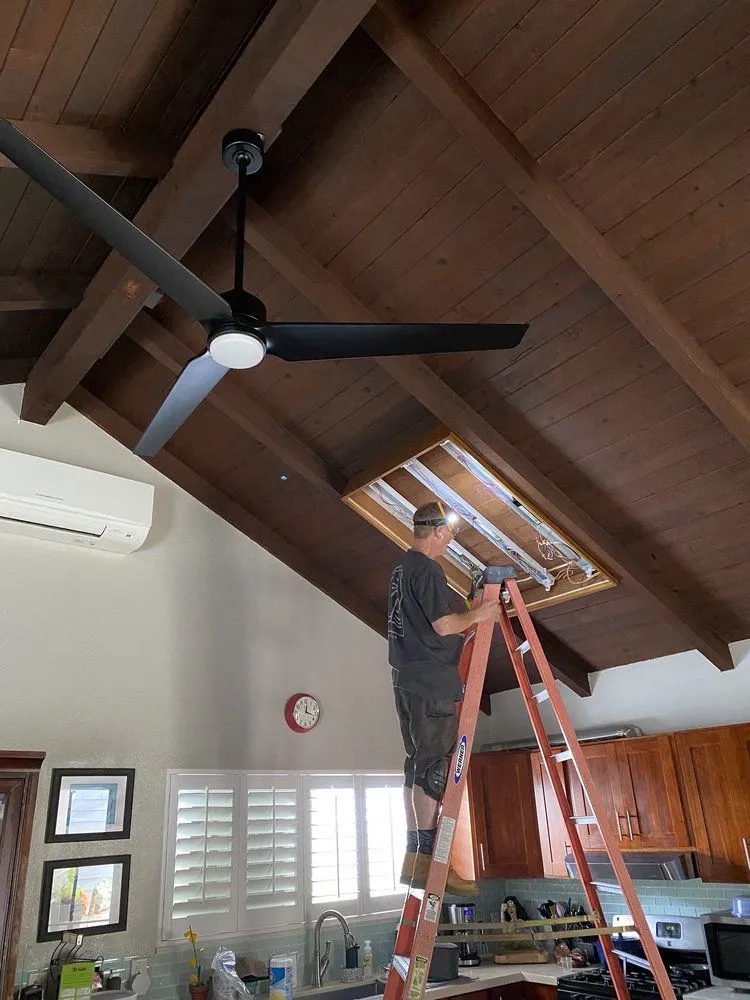
How a Repair Call Goes
Four steps. The second takes the longest, and it is the one that keeps us from having to come back.
Describe the Timing
Tell us when it happens and what is running. A trip that only comes at dinner already narrows the search.
Find It On Site
We load the circuit, test the outlets and open the panel until the fault shows itself.
Written Quote
What failed and what it takes to fix, put in writing before any tool comes out of the bag.
Fix and Test
The repair gets made, the circuit gets loaded back up, and we confirm with you that the problem is gone.
Why Families Here Trust the Visit
The Cause, Found
We would rather spend the time tracing a fault than replace parts that were never the problem.
Jerry and His Sons
A family shop, with Jerry in the trade since 1990. The people who look at your house are the ones who do the work.
Straight Answers
If a bigger breaker would be dangerous or a patch will not last, you hear that plainly and early.
What People Ask Before We Come Out
Our breaker trips when everyone is cooking and the AC is on. What is wrong?
An outlet feels warm. Can it wait?
We run extension cords because some rooms have no outlets. Is that okay?
Why do the lights flicker in more than one room?
How do I know if it needs a repair or something bigger?
Do repairs need a permit?
One Visit to Find the Fault
Tell us what trips or what feels warm, and when it happens. A licensed electrician traces it on site and puts the repair in a written quote before anything in the house gets touched.