Aiea Ceiling Fan Installation
Fan-rated box upgrades, wet-rated lanai fans, and full new-circuit installs for Aiea homes, from Newtown tract houses to hillside builds up in Aiea Heights.
Trade winds outside. Still air inside.
Aiea sits on the leeward slope above Pearl Harbor, and the trade winds that keep the island livable do not always make it through the walls of a house. Rooms tuck into the hillside off Aiea Heights Drive, tract homes in Newtown sit shoulder to shoulder with little cross-breeze, and condos in the Pearlridge corridor trap afternoon heat against west-facing lanais. A properly hung ceiling fan is the cheapest way to move that air, cut how long the AC runs, and knock a real number off a Hawaii power bill that is already among the highest in the country.
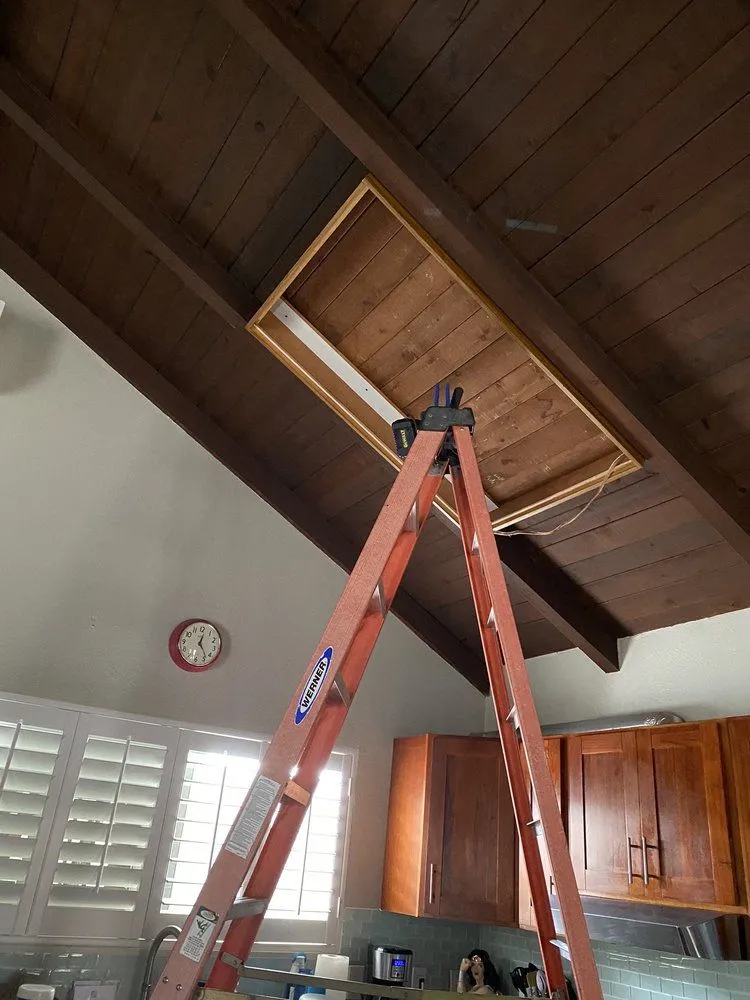
The job most Aiea homeowners think is simple usually is not. A homeowner buys a fan, gets up on the ladder, and finds the box in the ceiling is a standard light-fixture box rated for 35 pounds, not the fan-rated box a spinning motor needs. Hang a fan off the wrong box and you get wobble, a rattle that gets worse every month, and eventually a crack in the ceiling. We do the box swap the right way, bracing between the joists so the fan is anchored to structure, not just drywall.
We also put fans in rooms that have no ceiling box at all. That means running a new branch circuit or fishing a line from a nearby junction, cutting the opening at the correct joist bay, setting a rated box, and wiring a new wall switch or a light-and-fan pair. A lot of Aiea’s mid-century homes still carry aluminum branch wiring from the 1960s and 70s, which has to be landed with the right connectors and anti-oxidant compound. That is exactly the kind of detail a handyman skips and a licensed electrician does not.
What’s Included
Every Aiea ceiling fan install covers the same scope, from the box in the ceiling to the test spin at the end.
Why the box rating is the whole job.
Homeowners tend to think of a ceiling fan as a light fixture that spins, but the two are not wired or supported the same way. A light fixture is static weight. A fan is a spinning mass that puts a constant vibrating load on whatever holds it, which is why a fan-rated box is not a suggestion, it is code. The rating you want is a box marked for fan support, braced to the framing, not a plastic light box screwed into a single joist. When we open an Aiea ceiling and find a fixture box behind an existing fan, that fan is living on borrowed time, and the ceiling cracks and the wobble that get worse each month are the early warning.
Ceiling height drives the rest of the install. A lot of Aiea Heights homes and newer hillside builds have vaulted or 9 and 10-foot ceilings where a flush-mount fan sits too high to move air across the room. The fix is a downrod that drops the blades into the 8 to 9-foot range where airflow actually reaches you, sized to the ceiling. Sloped and vaulted ceilings need an angled mount and a longer downrod, and we carry the hardware so the fan hangs level and true no matter what the ceiling does above it. Blade span is matched to the room so a small bedroom gets a 44 to 52-inch fan and a great room gets a 52 to 60-inch one that actually moves the volume of air the space holds.
Then there is the island air. The trade winds that make a ceiling fan worth having are the same winds that carry salt and moisture into a covered lanai, and a standard indoor motor rusts from the inside within a couple of seasons in that exposure. We size a damp-rated motor for a covered lanai and a wet-rated one for an open lanai that catches rain, so the fan you pay for is still spinning in three years. Where a fan install adds enough new load to matter on an older Aiea panel, we check the service and coordinate with HECO on the utility side so nothing about the connection catches you off guard. All of it lands in a written quote first.
How It Works
Most Aiea fan installs are a same-day job. Here is the sequence from the first call to the running fan.
Walk the Room
We check the box type, joist layout, existing wiring, and switch location before anything comes off the ceiling.
Box Upgrade
Old fixture box out, fan-rated box braced between the joists and tied to structure so the fan does not wobble.
Hang and Wire
Fan assembled, wiring landed with the correct connectors, aluminum-safe hardware if the home needs it.
Test and Balance
Every speed run, wobble checked, switch and remote confirmed before we clean up and go.
Why Sparky
Box Done Right
We never hang a fan off a light-fixture box. The box upgrade is part of the job, not an add-on we talk you out of.
Aluminum-Aware
Aiea has plenty of 1960s and 70s homes with aluminum branch wiring. We carry the connectors and compound that make those connections safe.
Family Business
Jerry and his sons run this company. You get a licensed electrician who treats the fix like it is his own house, not a salesman.
Frequently Asked Questions
Can you install a ceiling fan where there is no existing fixture?
My Aiea home has aluminum wiring. Is that a problem?
Do I need a special fan for a lanai in Aiea?
What size fan should I put in an Aiea bedroom or living room?
How long does a standard replacement take?
Do you supply the fan or do I buy it?
Book an Aiea Ceiling Fan Install
Call or send a request and we will get out the same day or the next morning. You get a written quote up front, no surprise charges, and a real licensed electrician doing the work.
Talk To Sparky & Sons LLC
Reach out today for a fast, no-pressure quote. We look forward to working with you.