Plug In at Home. Wake Up Charged.
Hawaii has one of the highest EV adoption rates in the country, and the reasons are obvious once you live here. Gas costs what it costs on an island, most Oahu commutes are short, and the car sits in your carport overnight anyway. A Level 2 charger at home covers daily driving without a thought. The hard part is getting it wired right the first time, on a panel that was never designed with a car in mind.
Sparky and Sons installs every Level 2 charger on the market. Tesla Wall Connector, ChargePoint Home Flex, Wallbox, JuiceBox, Grizzl-E, and whatever came bundled with your car. We handle the panel-side work too. We meter your existing load, tell you straight whether your 100A or 200A service can carry a 40A or 48A charger, and either install on the existing panel or lay out what a service upgrade would take.
The first real decision is plug or hardwire. A NEMA 14-50 receptacle lets you unplug the unit and take it with you if you move, and it is the flexible choice if you are not sure what car you will own in five years. Hardwiring runs the conductors straight into the charger with no cord and no plug in the middle, which means no receptacle to overheat and, on most units, the ability to run the full 48 amps instead of being capped at 40. If the charger lives outdoors or in a carport exposed to salt air, hardwiring is what we usually recommend, simply because there is one less connection out there to corrode.
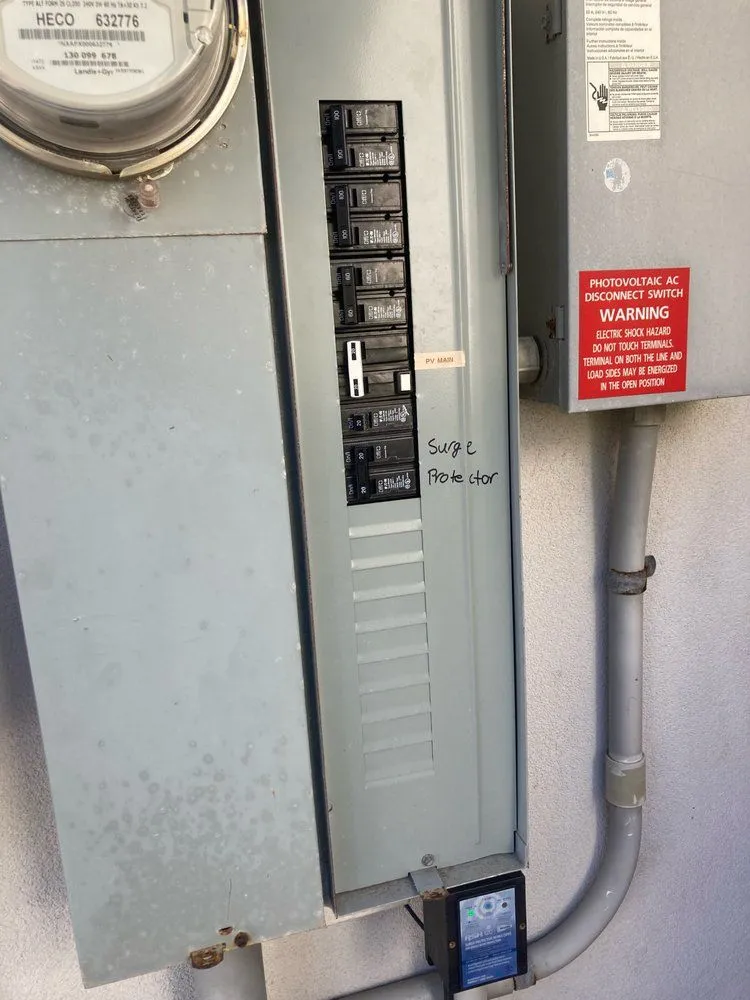
When the panel is tight, you still have options short of a full service upgrade. Most modern chargers can be dialed down in software to draw 32 or 24 amps instead of 48, which charges more slowly but still adds far more range overnight than you will typically use in a day. Some units support load management, where the charger watches the whole-house draw and backs itself off when the dryer and the AC are both running. There are also meter-collar and load-side tap devices that let a charger share capacity legitimately. We walk through which of those fit your panel and your driving, because the cheapest correct answer is often not the biggest one.
Carport and outdoor installs are the Hawaii-specific part. A lot of Oahu homes have no enclosed garage, so the charger ends up on an exterior wall or a carport post. That means a NEMA 4 or NEMA 3R rated unit, stainless or coated mounting hardware, conduit that is rated for sun and weather, and a cord holster mounted so the cable does not sit in a puddle. We also think about where you actually park and which side the charge port is on, because a beautifully installed charger on the wrong wall means dragging a cable around the car every night.
Connector standards are shifting right now and it causes a lot of confusion. J1772 is the older plug used by most non-Tesla EVs. NACS is the Tesla-style connector that other manufacturers are adopting on new models. In practice you are usually fine either way, because adapters exist in both directions and every charger we install will work with your car. What we do is ask what you drive now, what you think you will drive next, and pick a unit that will not be obsolete before the warranty runs out.
For Hawaii homes with solar, very common in Honolulu and Kailua, we wire the charger so it works with your production rather than against it. That usually means setting scheduled charging windows that line up with daytime generation when the car is home, or with your off-peak window when it is not. We are electricians and not your solar company, but we will make sure the two systems get along.
What’s Included
Here is what an EV charger job with us covers, from metering your panel to pairing the app.
How It Works
Four steps from first call to written warranty. No surprises along the way.
Audit & Quote
We meter your panel over a normal day of use, walk the conduit route from panel to parking spot, confirm which side your charge port is on, and write the quote.
Permit & Schedule
We pull the City and County permit and get you on the calendar, usually within a week when no service work is involved.
Install
Unit mounted at the right height, dedicated circuit run in rated conduit, breaker landed, and the whole thing tested under real charging load before we call it done.
Demo & Pair
We pair the charger with your car and your WiFi, set the scheduled charging window, and show you where the amperage setting lives in case you ever need it.
Why Sparky
Brand-Agnostic
We install whatever charger fits your car and your home best. We do not have a brand we push because somebody pays us to push it.
Panel-Aware
We size the install to your real panel capacity, measured rather than assumed, so you are not tripping the main every time the car and the dryer overlap.
HECO Rebate Help
We point you toward current HECO and federal programs you may qualify for. They change often, so we check what is live at the time of your quote.
Built for Carports
Most Oahu homes have no enclosed garage. We spec outdoor-rated units and hardware that will not be a rust stain in three years.
Upgrade Only If Needed
Plenty of 100A panels can carry a charger at a dialed-back amperage. We will tell you when that is true instead of quoting a service upgrade by reflex.
Permitted Work
Every charger goes in under a City and County permit and gets inspected, which matters for your insurance and for anyone who buys the house later.
Frequently Asked Questions
Do I need a 200A panel for a Level 2 charger?
How long does an install take?
Should I get a plug or a hardwired charger?
Can I get one charger that works for both Tesla and other EVs?
What if my panel is completely full?
What about HECO rebates?
Get a Free EV Charger Installation Quote
Written quote on the first visit. No surprise charges and no salesman act, just a licensed electrician answering your questions.
Charge in Your Own Carport
Tell us what you drive and where you park. We will meter the panel, pick the right unit, and give you a written quote before anything gets mounted.