Waipahu Ceiling Fan Installation
Moving air for leeward afternoons without piling load onto an older service. Braced boxes where a light box was left behind, low-profile mounts for low ceilings, and fans rated for the lanai.
Cooler rooms the old service can carry.
Afternoons get hot on this side of the island. Afternoons in a lot of these houses get warm and stay warm. The usual reaction is another window unit or a split AC, and in an older home still on a small original service, that can mean the lights dip every time a compressor kicks on. A ceiling fan draws a small fraction of that power.
That is why we often suggest fans first in older Waipahu homes, especially where a big family already runs several refrigerators, a rice cooker or two and an AC in the main room. Air moving across your skin makes a room feel cooler than the thermostat reads, so the AC can run fewer hours, or stay off entirely in bedrooms that only need a breeze at night. A fan will not stand in for air conditioning on the worst days. It takes a lot of pressure off the service the rest of the time, and nobody has to rethink the panel to add one.
See ceiling and lighting jobs in our project gallery, or tell us which rooms run hot and we will come take a look.

What goes into each fan we hang
One bedroom or every room in the house, the scope stays the same.
What we find above older Waipahu ceilings
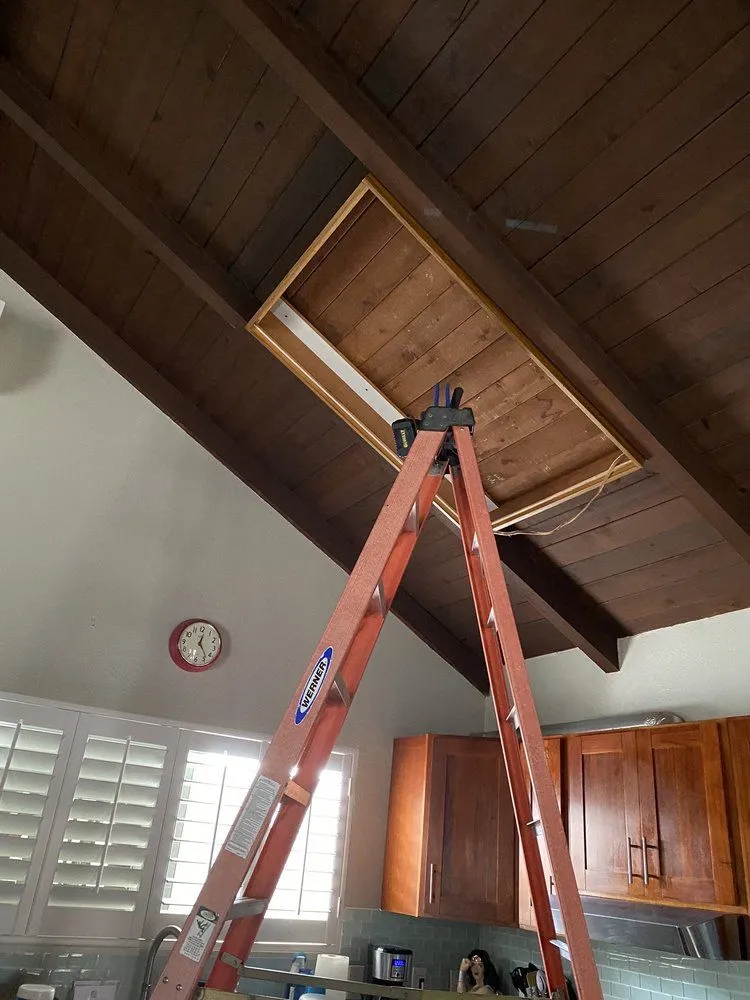
The most common thing we find when an old fixture comes down is a box that was only ever meant to hold a light. A lamp just hangs there. A fan motor turns for hours a day, and that small, constant vibration works a light box loose over time. First comes a wobble, then a tick on every rotation, then a crack creeping out from the canopy. We replace that box every time, however solid it feels, with a fan-rated box fastened to the framing above.
Ceiling height is the second thing. Many plantation-era and mid-century homes here have lower ceilings than the newer townhomes, and a fan on a standard downrod can put the blades uncomfortably close to anyone tall or anyone stretching. A hugger mount holds the fan tight to the ceiling. It moves a bit less air than a fan hanging lower, and in a low room that is the right trade.
Outside, the carport and the lanai need their own ratings, since an indoor fan does not hold up once moisture gets to the motor. And plenty of older fans in Waipahu still run off a pull chain, so every speed change means reaching up toward the blades. Adding a wall control usually means a new switch leg from the ceiling down to a wall box. In a single-wall house with no cavity to run it through, we plan that route with you before starting, often as a surface channel.
Where the fan goes matters as much as which fan you buy. In a long living room where the whole family gathers after dinner, one fan in the middle can leave both ends of the room still, and two smaller fans spaced along it often do more. Bedrooms usually want one fan centered over the bed. If a room already has a split AC head on the wall, a fan helps carry that cooled air across to the far side, so the unit is not straining to reach the corner by itself. We walk the rooms with you and suggest placements before quoting, including where a new box can go in a ceiling that has no fixture at all.
The order we work in
Nearly every fan job follows these four steps.
Look Up First
Box type, framing, ceiling height, and where a wall control can realistically go.
Put It in Writing
A written quote covering the box, the mount and any control wiring before any work starts.
Brace and Mount
Fan-rated box secured, fan assembled on the right mount, conductors joined properly.
Run It Through
Each speed and direction checked, wobble balanced out, and the controls shown to you.
How we handle fans
Every Box Replaced
If a fan is going up where a light used to hang, the box changes. That cost sits in your written quote from the start.
Fans Before Panels
When a room just needs air, we say so. A hot house does not always need a bigger service to get comfortable.
Family Electricians
Jerry and his sons run the company out of Honolulu, and Jerry has been an electrician since 1990.
Waipahu fan questions
Can a ceiling fan help if our electrical service is small?
There is already a light in that spot. Can the fan just go on that box?
Our ceiling is low. What kind of fan works?
Can you put a fan in the carport or on the lanai?
We only have a pull chain. Can you add a wall switch?
How do we get a written quote for a few rooms?
Put some air through the hot rooms
Point us at the bedrooms and the lanai that trap the afternoon heat. We check each ceiling and give you a written quote on the first visit.