Electrical Rewiring in Ewa Beach
The older houses near the shore and the plantation-era homes in Ewa Villages were wired for a quieter life. We replace what has aged out, run grounds where none were ever pulled, and keep the house livable while the work goes on.
What turns up behind old cover plates
Rewiring calls in Ewa Beach mostly come from two kinds of houses. One is the older home along the shoreline, in Ewa Beach town or Puuloa. The other is the former sugar-plantation camp house in Ewa Villages. Different streets, different histories, and once the cover plates come off they tend to show us the same handful of things.
Two-prong outlets sitting on circuits with no ground at all. Fixture boxes where years of heat from the bulb have baked the wire insulation brittle, so it cracks the moment you bend it. Splices tucked loose in a wall or ceiling with no box around them, wrapped in tape by somebody long gone. None of that means the house will fail tomorrow. It does mean every new appliance is plugged into wiring that was never planned to carry it.
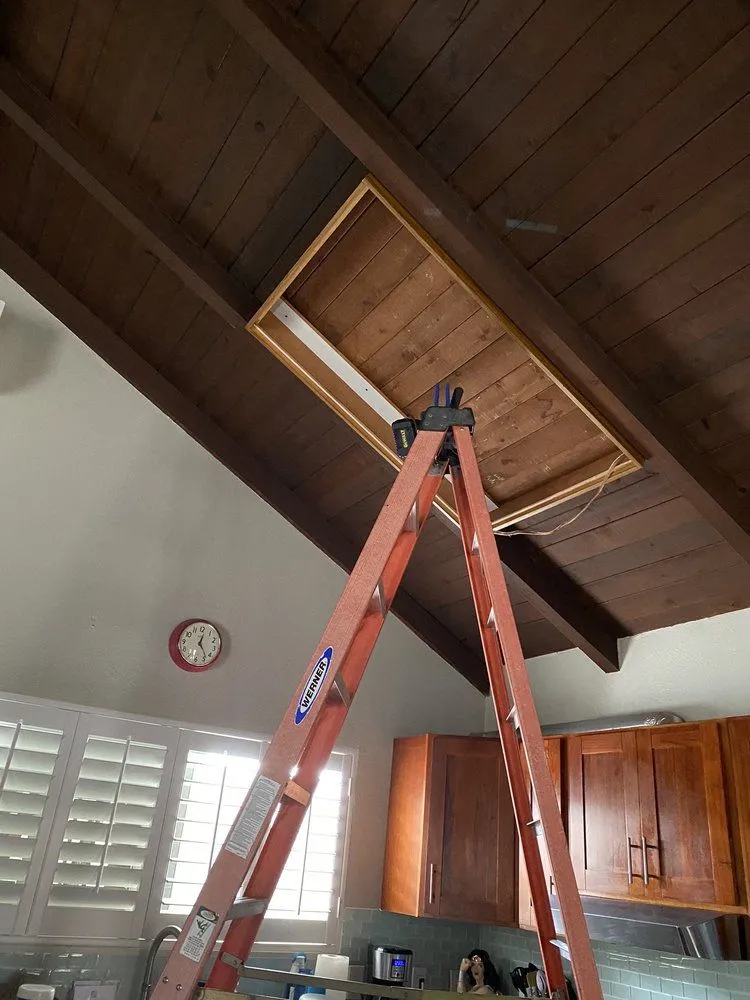
A lot of these homes are single-wall construction, and many have wood-plank ceilings like the kitchen in the photo here, with a loose wire hanging out of the opening above the ladder. That changes how a rewire gets done. In a framed wall with drywall we can usually fish a new cable through the cavity. A single wall has no cavity to fish through, and a plank ceiling has nowhere to hide a cable either.
So new runs go one of two ways. Up through the attic and down at a point we can reach, where the house gives us an attic to work in. Or in surface raceway along the wall, where it does not.
The attic route has its own rule out here: respect the heat. A roof that sits in leeward sun most of the year makes for a hot attic, so we keep cable off the underside of the roof deck, support it properly along the framing, and plan each trip up the ladder so the crew is not working in that heat any longer than the job needs.
Raceway has a bad name because it is so often installed badly. We keep it tight to trim lines and corners, hold consistent heights from room to room, paint it to match when you want it painted, and plan the whole route before the first piece goes up. Done that way, it reads as part of the house.
Grounding and protection come with the job. Every circuit we replace gets a new run with a ground in it, so a three-prong outlet finally means what it looks like it means. GFCI protection goes where water lives: kitchen counters, baths, laundry and the lanai. AFCI protection goes where the work calls for it. We explain what each one does on your walls in plain terms.
Leeward heat matters here too. Houses on the Ewa plain run AC for most of the year, and an older home that has added window units and a mini-split or two is often carrying those loads on circuits laid out for fans and a refrigerator. A rewire is the moment to give the AC its own circuits instead of sharing.
Not every older house needs the whole thing. Sometimes the bedrooms are fine and the kitchen is the trouble, or one bad circuit has been doing most of the damage. Homes in the newer master-planned neighborhoods, Ewa by Gentry, Ocean Pointe and Hoakalei, rarely call for a rewire at all; there we are more often adding circuits than replacing them. We would rather say that than sell a rewire nobody needs.
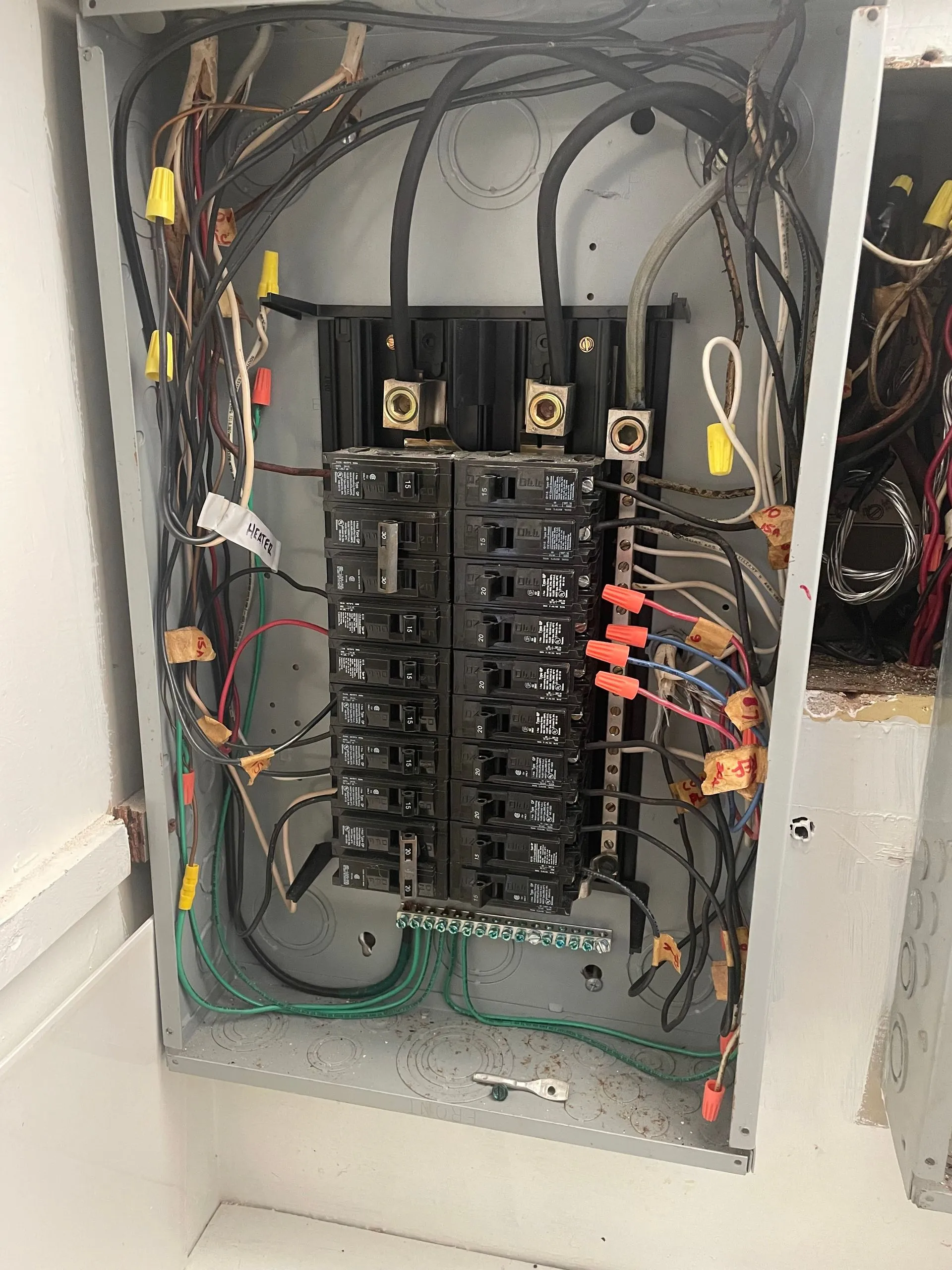
Most rewires end at the panel. An old panel with no spare spaces, tired connections and conductors crowding the sides cannot take a set of new circuits cleanly, and the second photo on this page shows exactly that kind of panel. When we reach that point we say so, and the next step is usually panel replacement. See finished jobs in our gallery, or tell us about the house and we will tell you what a rewire there tends to involve.
Rewiring with the family still at home
We do not need the house empty. We need a plan and a little patience from everybody.
Walk the House
Every room, every circuit at the panel, outlets tested. We note what can stay and what has to go.
Written Quote
Room by room and circuit by circuit, with the route each new run takes, all in writing.
One Circuit Down
We take a single circuit out of service at a time, so the fridge and the AC keep running elsewhere.
Test and Label
Each new circuit tested, labeled at the panel and shown to you before the next one comes down.
The parts a rewire replaces
Every house is different. These are the items that come up again and again in older Ewa Beach homes.
Why owners of older homes pick us
Patient With Old Houses
Single walls and plank ceilings take planning. We would rather plan a clean route than patch our way around the house.
A Father and His Sons
Jerry has been an electrician since 1990 and opened Sparky and Sons with his sons in 2020. Family-owned, licensed and insured.
No Scare Tactics
Old wiring is not automatically dangerous wiring. We tell you what is urgent, what can wait, and why.
Before a rewire, people ask
Do we have to move out while you rewire?
Can you rewire a single-wall house without tearing it apart?
Are my two-prong outlets dangerous?
Will a rewire mean a new panel?
Can you rewire one part of the house at a time?
Does a rewire need a permit and inspection?
Bring old circuits up to the house you live in
Tell us about the place: near the shore or in Ewa Villages, single-wall or framed, two-prong or grounded. We walk it, test what is there, and lay out the rewire room by room in a written quote. If only part of the house needs it, the quote says that too.