Surge Protection in Ewa Beach
Almost everything you plug into a house out here has a circuit board in it, and boards do not like spikes. A surge device at the meter-main or the panel takes the hit first. Strips at the TV and the desk handle what is left.
What a surge actually does to a house
A surge is a short burst of voltage above what your wiring is supposed to see. Most of them never make the news. Hawaiian Electric switches equipment on its lines, a transformer gets serviced, the power drops out on a hot afternoon and comes back all at once. Any of those can send a spike down the service drop and into every circuit you own. Storms play a part some years, but on the leeward side that is the exception, and we are not going to sell you a device with lightning stories.
The house makes spikes of its own, too. Every time an AC compressor, a pump or a garage door motor starts and stops, it pushes a small jolt back onto the wiring. One of those means nothing. Thousands a year landing on the same control boards is how a mini-split board quits early, or a range display goes dark with no obvious cause and no storm to blame.
That is the case for whole-home protection on the Ewa plain. Houses here run AC most of the year: window units in the older homes near the shore and in Ewa Villages, mini-split heads all through Ewa by Gentry, Ocean Pointe and Hoakalei. A lot of those roofs carry PV as well, which adds an inverter and a second source of power to plan around.
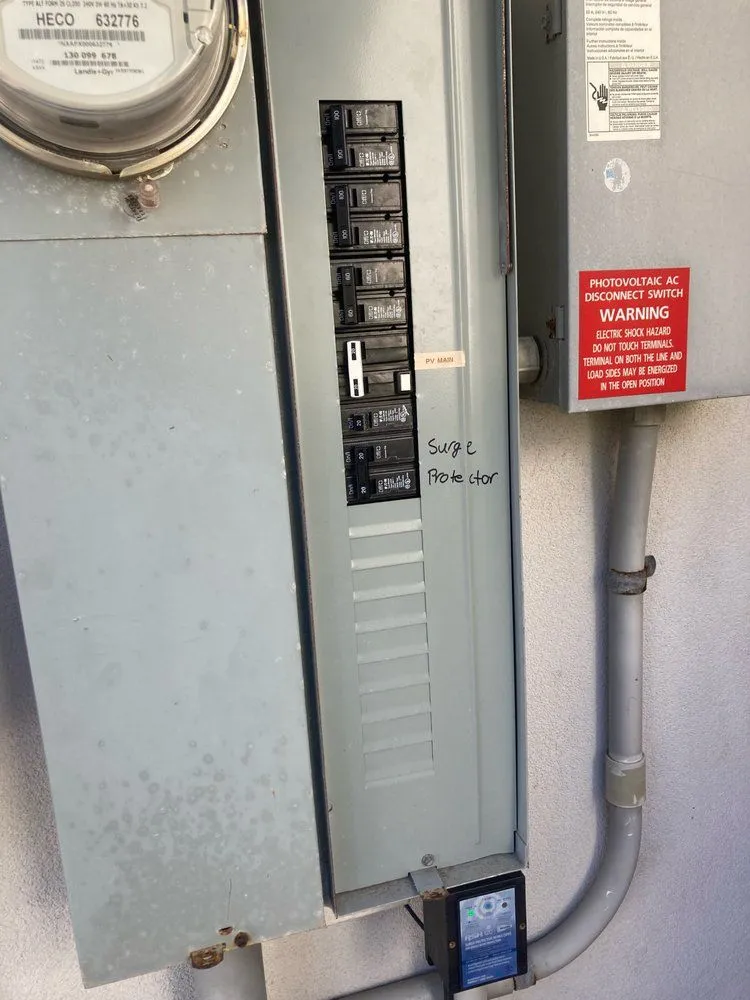
Where the device goes depends on what is on your wall. Plenty of homes here have a combined meter-main outside, with the meter on top and the main breaker below it. The photo on this page is one of those: a PV MAIN breaker in the column, a small surge device mounted under the enclosure, and a separate box carrying the red photovoltaic AC disconnect label. On a layout like that we land the device where it covers the whole panel and leave the solar disconnect clear and labeled, so whoever services the PV later is not hunting for it.
When the main breaker lives in an indoor panel instead, the device usually mounts at that panel on its own breaker, with the leads kept short. Long leads make a surge device less effective, so placement is a real decision and not an afterthought.
It is worth being plain about what a whole-home device does. It clamps a large spike down to a level the house can live with and sends the excess to ground. It does nothing during an outage and it will not make the power steadier. Whatever gets past it can still bother a desktop computer, a router or an AV receiver, which is why good point-of-use strips at those outlets still earn their spot.
A surge device also leans on the grounding system to do its work. In an older home with a weak or missing ground, we check that before anything else. If the circuits themselves are two-prong runs with no ground at all, the honest order is to sort the grounding out first, which our rewiring page walks through, and add protection after.
Near the shore, in Ewa Beach town, Iroquois Point and Puuloa, an outdoor enclosure lives in salt air all year. While we are at the meter-main we look at the cover, the lugs and the mounting, because a surge device bolted to a corroding enclosure will not last. If your panel is full or tired, we will say so, and that conversation may belong on our panel replacement page first.
Either way we look first and quote second. Browse finished jobs in the gallery, or tell us what is on your wall and we will tell you where a device would go.
What the device is guarding
Anything with a control board, which covers more of the house than most people expect.

How a surge job runs
Mostly looking and measuring before anything gets mounted.
Look at the Wall
A photo of your meter-main or panel helps. We check for PV, a disconnect and a spare space.
Pick the Spot
Meter-main or panel, which breaker, how short the leads can run. That decides how well it works.
Price in Writing
Device, location and installed price on a written quote before we open anything.
Install and Show You
Mounted, wired, power restored, and we point out the indicator light so you know what normal looks like.
Why leeward homeowners trust a family shop
Comfortable Around PV
We treat the inverter breaker and the AC disconnect as part of the layout, and we leave both clear and labeled.
Jerry on the Job
Jerry finished his apprenticeship in 1990 and opened the business with his sons in 2020.
Honest Scope
If good strips at the TV and desk are all you need right now, you will hear that before we sell you anything bigger.
Surge questions from leeward homeowners
Do I still need surge strips if I have a whole-home device?
How do I know the device is still working?
We have solar on the roof. Does that change anything?
Is lightning a big reason to install one here?
Can any panel take a surge device?
What should I do after a big surge or outage?
Protect the boards you already paid for
Send a photo of your meter-main or panel, or just describe it. We come out for a Free Look, check where the PV gear and disconnect sit, and put the device, the location and the price on a written quote. You decide from there, with no pressure either way.