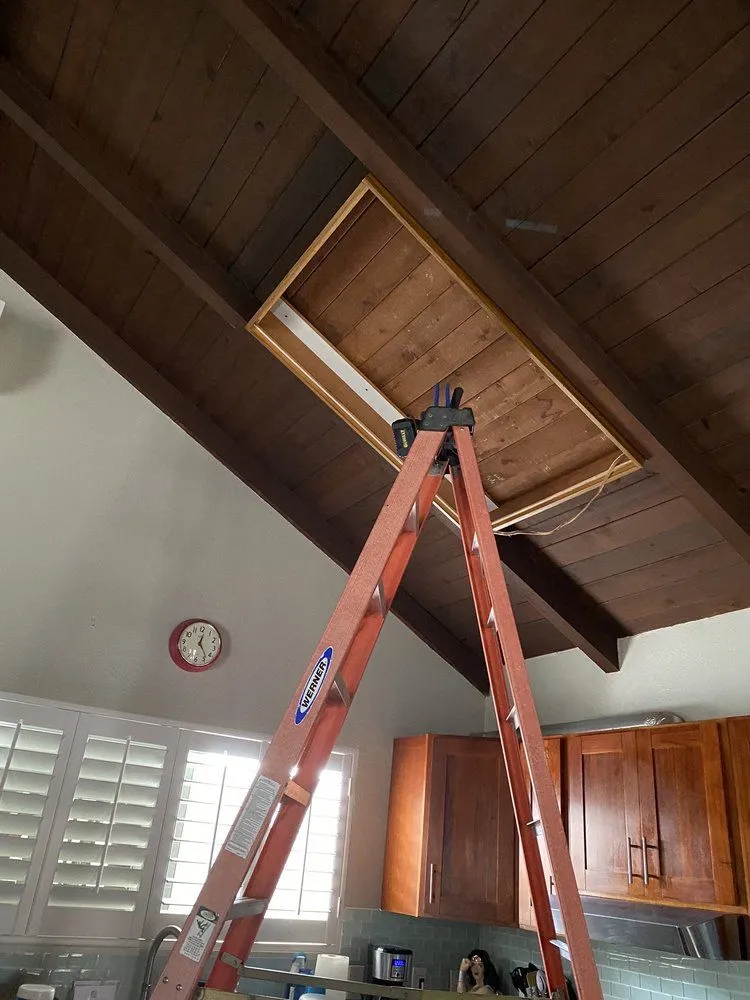
Walk into a Mililani living room built in the seventies or eighties and there is a decent chance the ceiling climbs away from you in wood planks. Those ceilings are the best thing about the houses and the reason a fan install here is a different job than a fan install under flat drywall. People buy the fan expecting an afternoon. Then they get up the ladder and find out the ceiling is not going to cooperate.
Nothing about it is exotic. It just has three parts that have to be right, and they have to be right in order.
The box is the whole job
Everything hanging from a ceiling is held by a box, and boxes are not interchangeable. A standard lighting box is designed to carry a fixture that hangs there and does nothing. A fan does not hang there. It spins, and while it spins it pulls sideways and up and down in small amounts, hour after hour, for years.
So a fan needs a box rated for a fan, fastened to actual framing. On a plank ceiling that framing sits above the visible wood, which means we are not just twisting a bracket into place from below. We find the member, anchor to it, and make sure the box sits flush to a surface that is sloped rather than level.
The failure mode when this is skipped is not subtle. A fan on a lighting box works fine for a while and then one day the screws have walked themselves loose and the whole thing is hanging by the wiring. That is the version of this story nobody wants to be in, and it is the reason we open the ceiling before we quote.

Slope changes the hardware
A flat ceiling gives a fan a level starting point. A vault does not. The canopy that covers the mount has to accept an angle, and not every fan ships with a canopy that will take a steep one. Some manufacturers publish a maximum slope for the hardware in the box, and some sell an angled mount separately that nobody at the store mentions.
This is worth knowing before the fan is purchased, because a beautiful fan that cannot legally or physically mount on your particular slope is a return trip and a restocking headache. When somebody asks us to look at a ceiling before they buy, we consider that a good use of an hour.
Plank ceilings add one wrinkle beyond the angle. The finish surface is wood, often stained decades ago and impossible to match, so every hole we make is a hole that stays visible if the fan ever comes down. We plan the location once, cut once, and keep the canopy sized to cover what we opened. Homeowners who have watched a previous contractor make three attempts at a mount know exactly why that matters.
Downrod length is a measurement, not a preference
High ceilings are why people put fans in these rooms, and they are also why the fan can end up doing nothing. A fan stuck tight against a peak twelve or fourteen feet up moves air across the ceiling and very little of it reaches anybody sitting down. Drop it too far and now it is a hazard in a room where someone raises their arms.
What we measure is peak height, slope angle, and the clearance the blades need from the sloped surface on every side. Those numbers pick the downrod. It is one of the few parts of this trade where the right answer is genuinely arithmetic, and it is also the part most often guessed at.
Rooms with a skylight add one more thing to think about, since the light coming down will throw blade shadows that flicker across the room if the fan sits in the wrong spot. We have moved a fan eighteen inches for exactly that reason and the homeowner noticed immediately.
Wobble is almost never the fan’s fault
A new fan that shakes gets blamed on the fan. Nine times out of ten the fault is upstream. The canopy is not seated flat against the slope, so the whole assembly starts life a degree off plumb. Or the box has a hair of play in it, invisible when still, amplified by a spinning mass. Or the downrod pin is in but the set screw never got torqued.
Blade balance is a real thing and balance kits exist for a reason. We just do not reach for one until the mount has been checked, because chasing balance on a bad mount is chasing your tail. If you have a fan already up that has never stopped shaking, that is a service call worth making before a bracket works loose on its own schedule.
What a fan does in a Central Oahu house
Mililani sits inland in Central Oahu, drier than the windward side but still humid, and a moving-air strategy does a lot of work here. Homes that added split AC heads during a remodel often run the fan alongside the AC rather than instead of it, which lets the head work less to hold the same comfort.
If the room is getting a fan as part of a broader lighting change, it usually makes sense to do both at once while the ceiling is open and the ladder is already up. Our lighting work around Mililani covers recessed cans, pendants and fan boxes on these plank ceilings, and the Mililani page has the rest of what we handle in town.
Questions people ask from the bottom of the ladder
Can a fan go where a light fixture used to be?
Only if the box behind that fixture is rated to carry a moving load, and on a vaulted plank ceiling it almost never is. A light box holds a few static pounds. A fan pulls in every direction while it spins. We open it up, look at what is actually anchored to the framing, and replace the box if it is a lighting box, which is the usual finding.
How long should the downrod be on a high vaulted ceiling?
Long enough to bring the blades down into the room and short enough that nobody is walking into them. The blades want clearance from the slope on every side, which is the part people miss when the ceiling climbs. We measure the peak height and the slope angle before ordering anything, because a downrod that is wrong by a foot turns a good fan into a disappointing one.
Why does a brand new fan still wobble?
Usually the mount, not the fan. A canopy that is not seated flat against the slope, a box with the smallest amount of play in it, or a downrod that is not truly plumb will all show up as wobble once the motor is at speed. Blade balance is real too, but we check the mount first because that is where the fault lives most of the time.
Let us look at the ceiling first
Tell us the room and the ceiling and we will tell you what the box situation is before you buy anything. Send us a photo and the details or call (808) 342-8195, and you will get a straight answer and a written quote.
Need a licensed Oahu electrician?
Jerry and the team at Sparky & Sons LLC handle it all, from a single fan box to a full panel. No job is too small. Clean work, island-wide.
Call (808) 342-8195Free Look