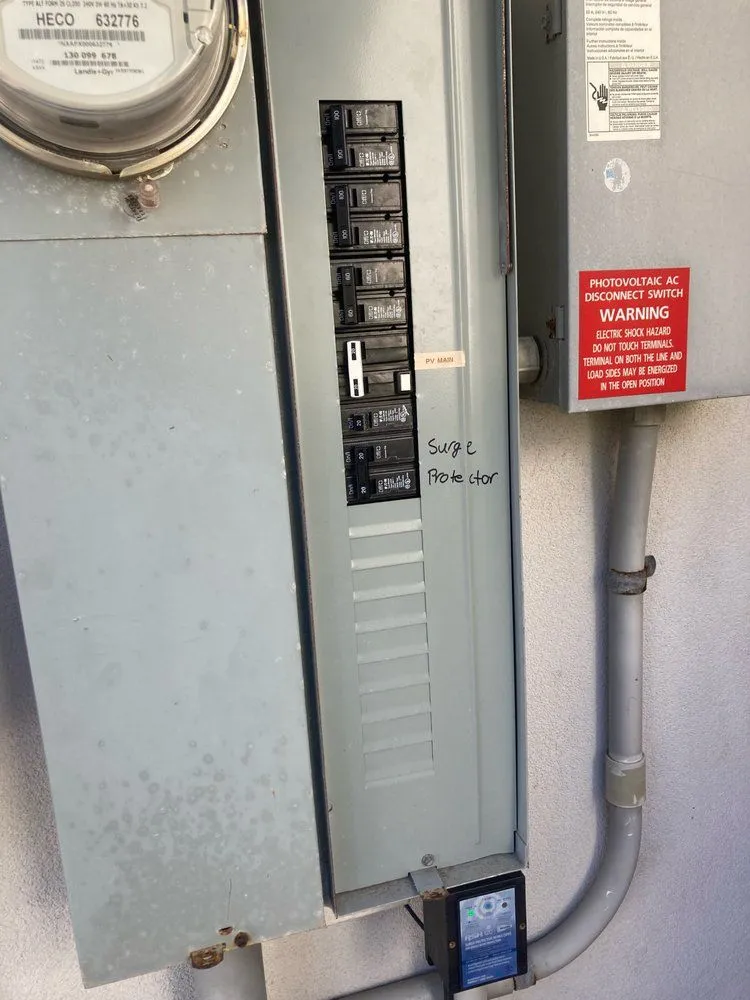
On a house with rooftop solar, the surge device usually lives at the meter-main or the main panel, next to the breaker that ties the solar in. It guards the electronics inside every modern appliance. Plug-in strips still belong behind the computer and the TV.
Drive down Fort Weaver Road on a clear afternoon and count the rooftops with solar panels. On the leeward side, with sun most of the year, a lot of homes have them, in the older parts of Ewa Beach and in the newer neighborhoods like Ewa by Gentry, Ocean Pointe and Hoakalei. A solar house has a slightly different electrical layout from one without, and that changes where surge protection goes and how it gets wired. This post walks through it the way we would at your meter, without the sales talk.
Where a surge comes from on a sunny street
A surge is a short spike in voltage, over in a fraction of a second, that rides in on the wires. People picture lightning, but that is not the everyday cause here. Far more often the source is ordinary utility work: switching on the grid, a transformer coming back after an outage, or the moment power returns to a whole neighborhood at once. Storms can bring them too.
Some spikes are made inside the house. Every time a compressor or a motor starts and stops, the AC, the fridge, the pool pump, it puts a small bump on the wiring. One bump does nothing you can see. Thousands of them over a few years wear down the electronics in everything plugged in.
That is the whole point of a whole-home device. It sits where power enters the house and clamps the big spikes before they reach the circuits. It does not stop an outage. It does not make anything run better. It limits damage from one specific kind of event.
Reading the gray box on the wall
On many homes out here, the outside of the house has a meter-main: one gray enclosure holding the Hawaiian Electric meter and the main breakers together. On a solar house, that box usually carries a breaker labeled for the PV system, and somewhere nearby there is a separate AC disconnect for the solar with a red warning label.
A whole-home surge device mounts right there, either on the enclosure or tied to a pair of breakers inside it. Placement matters. The leads should be short and straight, because every extra inch of wire weakens how well the device clamps a spike. The device also has to be the right type for the location, before or after the main breaker.
We label it clearly, so the next person who opens the panel knows which breakers feed it and does not shut it off by mistake. If your meter-main has no free spaces, there are devices that mount differently, and we will show you which one fits. The full rundown is on our surge protection page for Ewa Beach.
How the solar changes the plan
A house without solar has power coming from one direction, the utility. A house with solar has a second source on the roof, feeding through the inverter and back into the panel. With two sources in play, we trace the whole path before choosing a spot.
The inverter connects to the house on its AC side, through that PV breaker and the disconnect. A device at the meter-main or main panel covers that connection along with the rest of the house. The rooftop side, the panels and the wiring down to the inverter, is a separate part of the system and some installations carry their own protection there.
We work on the house side. If anything on the solar side should change, that is a conversation with whoever installed and services the system, and we are happy to talk it through with them. When a panel is crowded or tired, the surge device sometimes goes in during a panel replacement, which keeps the layout clean.
What it actually protects
What a surge damages in a modern house is the circuit boards that now live in almost everything.
Mini-split heads and their outdoor units each have control boards, and on the leeward side those systems run hard. The fridge has one. So does the range, the washer and the dryer. Garage door openers do. LED light kits in ceiling fans have drivers that fail from repeated small spikes. The TV and the router, obviously.
When a board fails, the appliance stops, and replacing one part can mean waiting on a shipment. A whole-home device takes away one of the steady things wearing them down, which is a reasonable thing to want in a house full of electronics running in the heat.

The strips behind the desk, and the little light
A device at the panel takes the big spikes. It does not catch everything. What gets past it, and the small spikes made inside the house, are why a good plug-in strip still belongs behind the computer, the TV and the audio gear. Think of it as two layers, one at the door and one at the outlet.
Both kinds wear out by doing their job. Each time they absorb a spike, a little of their capacity is used up. Most whole-home devices have an indicator light or a small window on the face. Check it a couple of times a year, and after any big outage or storm. If it is dark or showing a fault, it needs replacing. Plug-in strips with an indicator work the same way. If the house has other odd electrical behavior after an event, our troubleshooting visits are where we track it down.
Surge questions from solar homes
Does a whole-home surge device protect my solar inverter?
It helps on the AC side, where the inverter ties into the house. The panels on the roof and the wiring between them and the inverter are a separate part of the system, and some setups carry their own protection there. If anything on the solar side needs to change, that is a conversation with whoever installed and services the system, and we are glad to talk it through with them.
Do I still need plug-in surge strips?
For computers, TVs and audio gear, yes. A device at the panel takes the big hits coming in from outside. A good strip at the outlet handles what gets past it, plus the smaller spikes made inside the house when motors and compressors cycle. The two work as layers. Look for a strip with a protection indicator, and replace it when that light goes out.
How do I know my surge device is still working?
Most whole-home devices have an indicator light or a small window on the face. Lit or green usually means protection is active. If it is dark or showing a fault, the device has done its job and needs replacing. Glance at it a couple of times a year and after any big outage or storm. If you are not sure what you are looking at, send us a photo.
Start with a picture of the meter
A photo of your meter-main with the door open shows us most of what we need. Send it over or call (808) 342-8195 for a straight answer on where a device would go, and see our Ewa Beach page for the rest of what we do in town.
Need a licensed Oahu electrician?
Jerry and the team at Sparky & Sons LLC handle it all, from a surge device at the meter to a dead garage opener. No job is too small. Clean work, island-wide.
Call (808) 342-8195Free Look