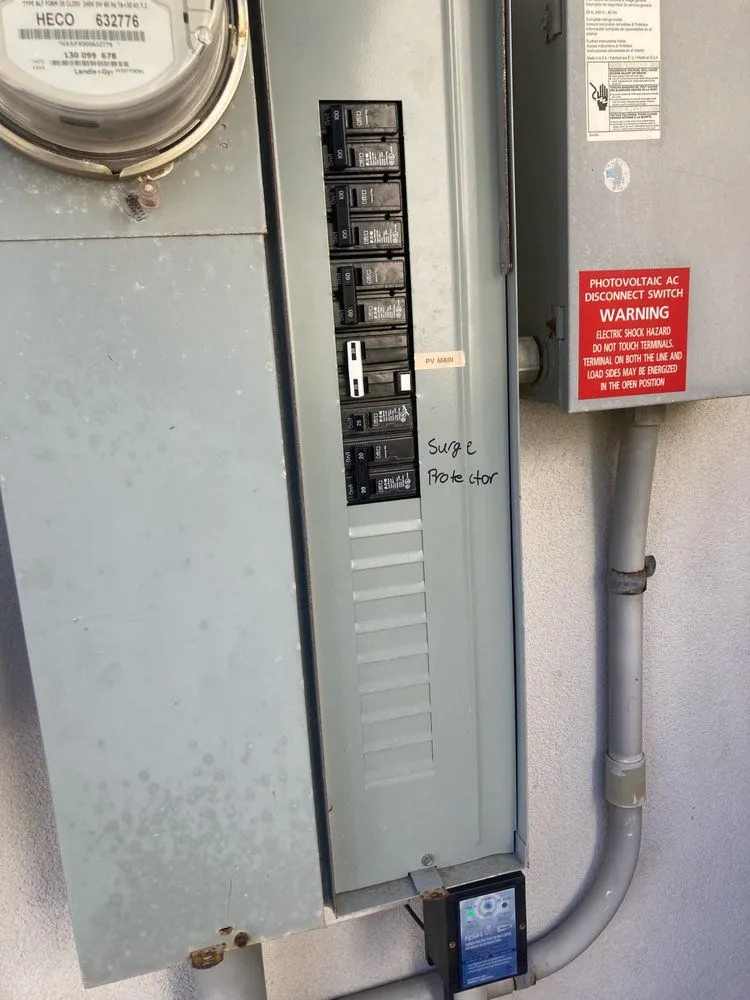
A whole-home surge protective device installed at your panel costs far less than the electronics it protects. On Oahu, surges come from grid switching, lightning during Kona storms, and salt-air-corroded connections, not just direct strikes. For most Honolulu homes it is a worthwhile, low-cost upgrade, and it matters even more now that homes carry expensive heat pumps, EV chargers, and solar inverters.
Most people picture a lightning bolt when they hear the word surge. On Oahu, the bigger everyday threat is quieter. Voltage spikes come from the HECO grid switching loads, transformers cycling, and aging connections that corrode in the island air. Every one of those events sends a small jolt through your wiring, and over time they degrade the sensitive electronics in your home.
I am Jerry, and I have wired and repaired island homes since 1990. A single power strip behind the TV is not real protection. The protection that actually saves your gear starts at the panel, and on this island it is one of the smartest few hundred dollars you can spend.
How whole-home surge protection works
A whole-home surge protective device (SPD) installs directly at your electrical panel. When a voltage spike comes down the line, the device diverts the excess energy to ground before it reaches your branch circuits. It reacts in nanoseconds and clamps the voltage to a safe level, protecting everything downstream, including your refrigerator, AC, heat pump, computers, and increasingly the EV charger and solar inverter. It is the same principle as a plug-in strip, but installed where it can guard the whole house, handle far more energy, and survive the island climate.
Type 1 and Type 2 SPDs, and which you need
Not all whole-home protectors are the same, and the difference matters. A Type 1 SPD is rated to install on the line side of your main breaker, between the utility service and the panel. It catches the larger, externally generated surges, including those induced by nearby lightning, before they even reach the main. A Type 2 SPD installs on the load side of the main breaker, inside the panel, and protects your branch circuits from both incoming surges and the internal spikes your own equipment creates when motors and compressors cycle. Most Oahu homes do well with a quality Type 2 device, and homes in exposed coastal or storm-prone areas benefit from a Type 1 and Type 2 combination. We tell you which fits your situation instead of overselling.
What a spike does to a heat pump or solar inverter
This is where the dollars get real. A solar inverter is the brain of your rooftop system, and a bad grid-side spike can fry its electronics in an instant. Replacing one runs into the thousands, and you lose production every day it is down. A heat pump, whether it is your AC or your water heater, carries sensitive control boards and a compressor that does not tolerate voltage swings. A single surge can take out the control board, and on this island a service call plus parts is never cheap. Compare that against the cost of an SPD and the decision makes itself.
Cheap SPD versus a quality one: joule rating and clamping voltage
Two numbers separate a device that lasts from one that fails when you need it. The joule rating tells you how much energy the SPD can absorb over its life before it wears out. A low-end unit might be rated for a fraction of a quality device, which means fewer big events before it stops protecting. The clamping voltage tells you how low the SPD pins the voltage during a surge. A lower clamping voltage means more of the spike gets knocked down before it reaches your equipment. A cheap protector with a high clamping voltage and a thin joule rating gives you a false sense of security. We install units sized for real island conditions, not the bargain-bin part.
Why Oahu and island grids are exposed
- Grid switching transients. Routine utility operations cause small surges dozens of times a day. These are the spikes that slowly kill electronics.
- Island grid isolation. Oahu runs on its own isolated grid with no mainland interconnection to absorb swings. When HECO switches loads, those transients have nowhere to dissipate, so island grids see more switching activity than a large connected grid.
- Kona storms and lightning. Hawaii gets fewer strikes than the mainland, but a nearby strike during a Kona storm still induces a surge on the lines feeding your home.
- Salt air and humidity. Corroded grounds and loose connections make a home more vulnerable to surge damage. We see this constantly on coastal Oahu properties.
- More sensitive loads. Modern homes pack in more electronics, smart devices, and inverters than the original wiring was designed to protect.
Check your grounding before you install
An SPD is only as good as the ground it dumps energy into. If your grounding electrode system is corroded, undersized, or never bonded properly, the protector has nowhere to send the surge and it will not perform when it matters. On older Honolulu homes and salt-exposed coastal properties, the ground rod and bonding are often the weak link. Before we install surge protection, we check that your grounding and bonding actually meet the NEC, and we correct it if it does not. That step is what separates a real install from a part that just looks installed.
What a licensed install includes versus a DIY job that fails
An SPD has to be wired with short, correct leads to a properly bonded ground, mounted as close to the panel as possible, and protected by the right breaker. A DIY job with long, looping leads adds impedance, which raises the let-through voltage and quietly defeats the whole point. We see DIY devices that read as connected but do nothing in a real event. A licensed install means correct leads, verified grounding, the right device type and rating, and a system that performs when a spike actually arrives. We install surge protection for homes and businesses across Honolulu, Aiea, Kailua, and Kaneohe. See our work in the gallery, contact us, or call (808) 342-8195 to add surge protection to your home.
Frequently Asked Questions
Will a whole-home surge protector stop a direct lightning strike?
No device can fully absorb a direct strike, and those are rare and extreme. An SPD is designed for the far more common induced surges and grid switching spikes, which is where almost all real-world damage comes from. Pairing a Type 1 and Type 2 device gives you the strongest defense against storm-induced surges. For the headline-grabbing direct hit, nothing short of a dedicated lightning protection system applies, and those events are vanishingly rare here.
What is the difference between a Type 1 and Type 2 SPD?
A Type 1 device installs on the line side of your main breaker and catches larger externally generated surges before they reach the panel. A Type 2 device installs on the load side inside the panel and protects your branch circuits from both incoming and internally generated spikes. Most Oahu homes do well with a quality Type 2, and exposed coastal or storm-prone homes benefit from both. We recommend the combination that fits your house and budget.
Do I still need power strips at my outlets?
For your most sensitive electronics, yes. A layered approach is best, where the panel device handles the large energy and point-of-use protectors guard individual devices like a home office or entertainment center. The SPD knocks down the big spike and the local strip cleans up what is left. The two together cost very little and cover almost everything.
How do I know if my grounding is good enough?
You usually cannot tell by looking, because corrosion and loose bonding hide behind covers and underground. On older or coastal Oahu homes, the ground rod and bonding are frequently the weak point. We test and inspect your grounding electrode system before installing any SPD and correct anything that does not meet the NEC. A surge protector on a bad ground is a part that does nothing.
How long does installation take?
A standalone whole-home SPD install is usually done in under two hours. If we are already doing panel work or a service upgrade, we add it at the same time and save you a separate visit. We verify the grounding while we are in the panel. You are protected the same day.
Does it need maintenance?
Most modern SPDs have an indicator light that shows they are still protecting. If that light goes out after a major event, the device has done its job and should be replaced. We can check it on any service visit. A device is a sacrificial part, so confirming it is still live is worth doing once a year.
Is surge protection worth it with solar?
Especially so. Inverters are expensive and sensitive, and a single grid-side spike can cost you thousands plus lost production. An SPD helps protect that investment from the switching transients that island grids produce regularly. If you have solar or an EV charger, surge protection is one of the easiest ways to safeguard the gear.
Need a licensed Oahu electrician?
Jerry and the team at Sparky & Sons LLC handle it all, from a single outlet to a full panel. No job is too small. Honest pricing, clean work, island-wide.
Call (808) 342-8195Request Service