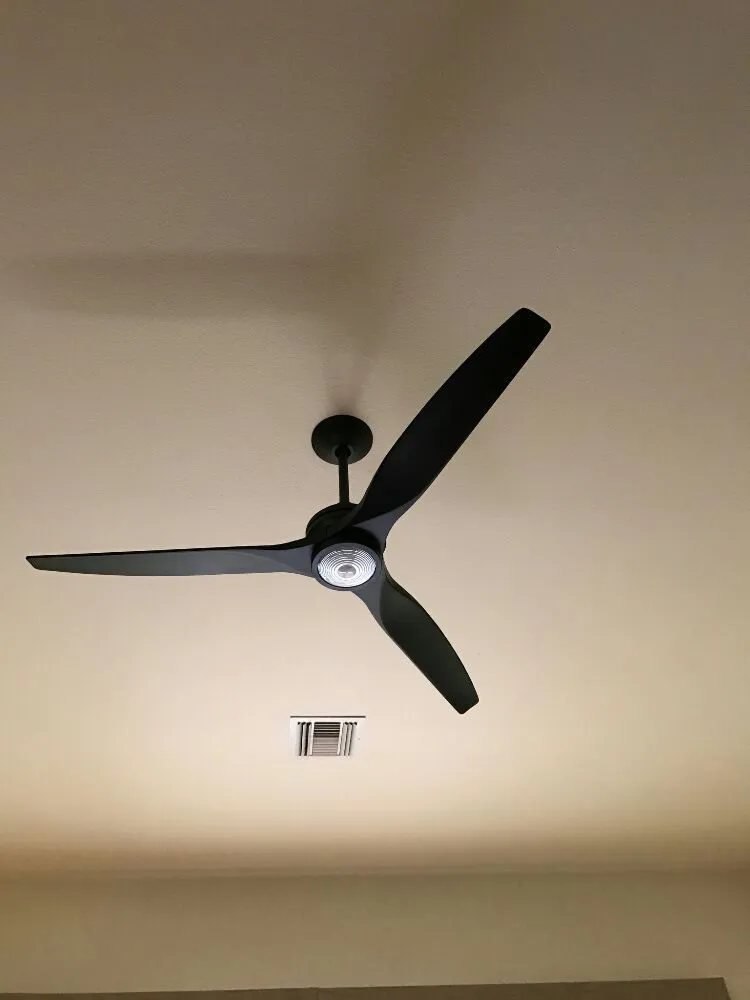
In Hawaii’s climate, a ceiling fan lets you feel comfortable at a higher thermostat setting, which directly lowers your bill on Oahu’s high-cost grid. The key is a fan-rated box, secure mounting, the right blade span for the room, and correct wiring, especially on the vaulted and beam ceilings common in island homes.
With some of the highest electricity rates in the country, every degree you ask of the thermostat costs Oahu homeowners real money. A ceiling fan is one of the simplest, cheapest ways to stay comfortable while running the AC less, or skipping it entirely on a breezy afternoon. A fan does not actually lower the room temperature, but the moving air pulls heat off your skin and makes you feel several degrees cooler, so you can bump the thermostat up and never notice the difference except on the bill. My sons and I install these every week across the island, and I want to walk you through the parts that actually matter so you get a fan that works, stays quiet, and lasts.
The real energy math
Let me put numbers to it, because this is where people underestimate the win. A typical ceiling fan draws somewhere between 30 and 75 watts on a normal speed. A window AC unit draws anywhere from 500 to 1,500 watts, and a central system pulls far more. So running a fan to feel comfortable enough to raise your AC even two or three degrees is not close, it is a landslide. On Oahu’s rates, where you pay roughly two to three times the national average per kilowatt-hour, that gap shows up in dollars every month. A fan does not replace AC on a brutal day, but for most of the year it lets the AC run less and shorter, and that is the whole game here.
What makes a fan actually move air
Not all fans push the same amount of air, and the cheap ones at the big-box store are cheap for a reason. Two things separate a fan that cools you from a fan that just spins prettily: blade pitch and motor quality. Blade pitch is the angle of the blades, and you want something in the 12 to 15 degree range. Flat blades barely scoop air. A flimsy motor cannot drive a steep pitch without straining, getting loud, and dying early, so a real fan pairs a meaningful pitch with a motor built to turn it. When I help a customer pick a fan, this is the conversation I push hardest, because a well-built fan at a fair price will outperform a flashy cheap one and outlast it by a decade.
Wet-rated, damp-rated, and where each goes
This matters a lot in Hawaii because so many homes have lanais and covered carports. A wet-rated fan can take direct exposure to rain and blowing moisture, so that is what belongs on an open lanai or any spot that catches windblown rain off the trades. A damp-rated fan handles humidity and the occasional splash but not a soaking, which makes it right for a covered carport, a screened porch, or a steamy bathroom. An indoor-rated fan in either of those spots will rust out the motor and bearings fast in our salt air. Putting the right rating in the right place is not a detail, it is the difference between a fan that lasts and one you replace in two years.
Picking the blade span for the room
Size matters more than people think. A fan that is too small for a room just stirs the air over your head and never reaches you, and one that is too big in a small room is overwhelming. The rough rule we use: 52 inches for rooms under about 225 square feet, a standard bedroom or office, and 60 inches or more for larger living rooms and great rooms. Very small rooms like a laundry or a small office do fine with 44 inches. Get the span right and the fan feels effortless. Get it wrong and you will run it on high all the time and still feel warm.
Why the mounting box is the whole ballgame
A ceiling fan is a heavy object spinning over your head, so it has to hang from a fan-rated electrical box anchored to the structure, not the standard light box that came with the fixture. This is the single most common mistake we get called to fix. When a fan goes up on a plain light box, here is the sequence: the box flexes a little with every rotation, the mounting screws slowly back out under the constant motion, the fan starts to wobble, the wobble gets worse, and eventually the whole thing comes down. A fan-rated box is built to carry both the dead weight and the dynamic load of the spin. Skipping it is the kind of shortcut that looks fine on day one and becomes a hazard a year later.
The direction switch most people never touch
Look on the motor housing and you will find a little switch that reverses the blade direction. In the warm months, you want the fan spinning counterclockwise so it pushes air straight down and creates that cooling breeze on your skin. In the cooler, breezier stretch of our mild Hawaiian winter, flipping it to clockwise on a low speed pulls air up and gently redistributes the warmer air that collects near the ceiling, which evens out a room without a draft. It is a small thing, but it is free comfort, and almost nobody uses it.
Smart controls and why you cannot just slap a dimmer on it
People ask all the time why they cannot put their old dimmer on a fan to slow it down. A standard light dimmer chops the voltage in a way that makes a fan motor hum, overheat, and fail, so you need a proper fan speed control or the remote and receiver the manufacturer designed for it. The good news is that modern fans come with quiet wall controls, handheld remotes, and even app and voice control, and we can wire separate switches so the light and the fan run independently. The most common upgrade we are doing on Oahu right now is exactly this: pulling out old pull-chain fans and replacing them with quiet, efficient models on a clean wall control, often on the high and sloped ceilings that scare off the DIY crowd. This is routine ceiling fan installation for us.
Vaulted, beam, and the homes that have them
So many Oahu homes have those gorgeous open-beam and vaulted wood ceilings. They look incredible and they take real experience to wire and mount safely, with a downrod sized to the slope and careful routing through the structure. We also handle the upstream work when there is no overhead box at all, which means running new wiring, adding a switch, and sometimes pulling a new circuit, the kind of job that should be done by a licensed electrician so it is safe and to code. If you are not sure your room can take a fan, that is exactly the question we are happy to answer.
Do it once, do it right
A correctly installed fan runs quiet, balanced, and safe for years, and a wrong one wobbles, hums, and lands in a landfill. We install and replace ceiling fans throughout Honolulu, Aiea, Kailua, and Kaneohe, including the tricky high and sloped ceilings. Take a look at our project gallery, then reach out or call (808) 342-8195 and we will get the breeze flowing.
Frequently Asked Questions
Will a ceiling fan really lower my electric bill?
Indirectly, yes, and the math is lopsided in your favor. A fan draws roughly 30 to 75 watts while a window AC pulls 500 to 1,500 watts, so running a fan to stay comfortable at a higher thermostat setting trims real money off Oahu’s high rates. The fan does not cool the room, it cools you, which lets the AC run less and shorter. Over a year that adds up to a noticeable dent in your bill.
Can I put a fan where I only have a light fixture?
Usually yes, but the existing light box has to be swapped for a fan-rated box that is anchored to the structure and built to carry the weight and the spinning motion. A standard light box will flex, loosen its screws over time, and let the fan wobble and eventually fall. We handle that swap as part of the install so the fan is mounted safely from day one. Never hang a fan on a box that was meant for a light.
What size fan do I need for my room?
As a rule of thumb, a 52-inch fan suits rooms under about 225 square feet like a standard bedroom or office, and 60 inches or larger is right for big living rooms and great rooms. Very small rooms do fine with 44 inches. Getting the span right means the fan actually moves air to where you sit instead of just stirring it near the ceiling. We will measure and recommend the right size when we come out.
My ceiling is vaulted and made of wood beams. Can you still install a fan?
Absolutely, and it is some of our most common work on Oahu. Sloped and open-beam ceilings need a downrod sized to the angle and careful routing of the wiring through the structure, which is exactly the kind of job where experience matters. We mount it level, balanced, and safe so it runs quiet on a high ceiling. If there is no existing box up there, we can run the wiring and add the switch too.
Why does my existing fan wobble?
Wobble usually comes from one of two things: an unbalanced blade set, which is a quick fix with a balancing kit, or the more serious problem of a fan hung on a box that was never rated for it. If the box is flexing, the wobble will only get worse and the mounting can fail over time. We can re-balance a sound install or re-mount the fan on a proper fan-rated box. A fan should run smooth enough that you forget it is moving.
Can I use my regular dimmer to control fan speed?
No, and this is a common mistake. A standard light dimmer chops the voltage in a way that makes a fan motor hum, run hot, and fail early. You need a dedicated fan speed control or the remote and receiver the fan was designed to use. Modern fans come with quiet wall controls and handheld or app-based remotes, and we wire the fan and light on separate controls so you can run them independently.
What direction should my fan spin?
In the warm months, set it counterclockwise so it pushes air down and creates a cooling breeze you actually feel. In our cooler, breezier winter stretch, flip the switch on the motor to clockwise on a low speed to gently pull air up and even out the warmer air near the ceiling without a draft. There is a small reverse switch on the motor housing for exactly this. Most people never touch it, and it is free comfort.
Need a licensed Oahu electrician?
Jerry and the team at Sparky & Sons LLC handle it all, from a single outlet to a full panel. No job is too small. Honest pricing, clean work, island-wide.
Call (808) 342-8195Request Service