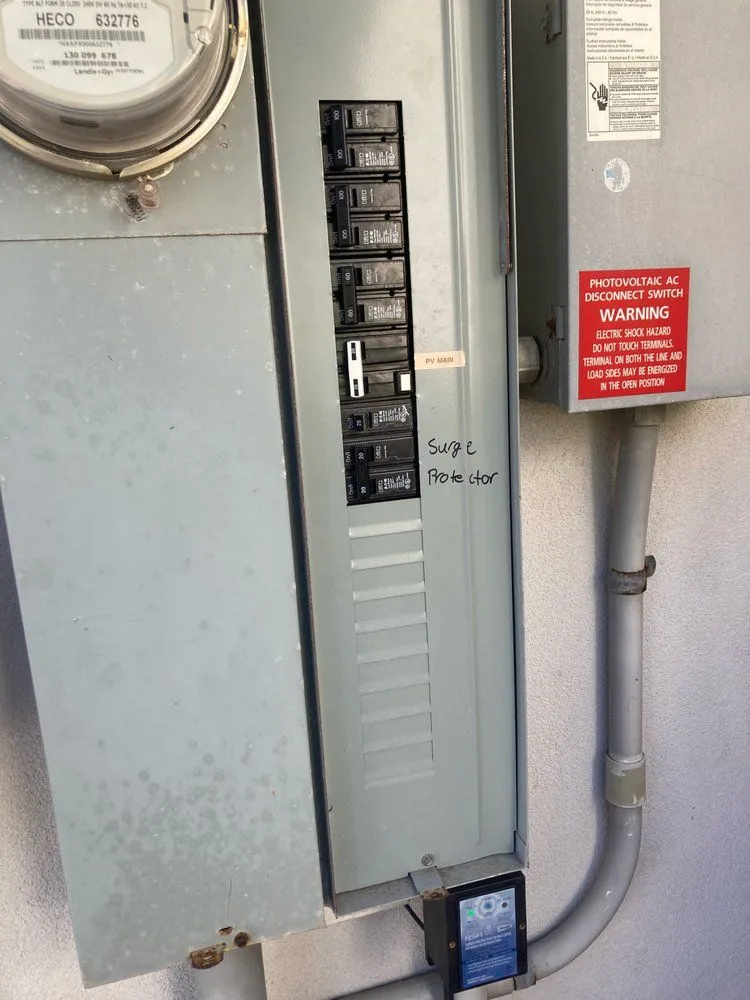
The car shows up in the driveway before anybody thinks about the garage wall. That is the normal order of things, and it is why most of our Mililani charger calls start with a homeowner who already has the vehicle and a question about whether the house can feed it. I am Jerry. My sons and I have been doing this work on Oahu a long time, and the answer never comes from looking at the panel door. It comes from arithmetic we do before we quote anything.
Mililani Town was laid out from 1968 onward, and a lot of the original single-family stock is still carrying its original service. That is not automatically a problem. It is just the reason we measure instead of assume.
What the panel door tells us and what it hides
Open a panel in an older Mililani house and the first number we want is the main breaker rating. That number is the ceiling on everything. Below it sits whatever the household has added over fifty-odd years: a second refrigerator in the garage, split AC heads that went in during a remodel, an induction range that replaced a gas cooktop, a spa, a shop compressor.
None of that shows up on the label. The label was printed the year the house went up and it has been wrong since about the first renovation. So we count breakers, trace what each one actually serves, and write down nameplate ratings off the equipment itself. A dryer that says thirty amps on the back of the drum is worth more to us than a dryer somebody remembers being thirty amps.
The other thing the door hides is condition. Rust at the bottom of an outdoor enclosure, heat discoloration on a bus stab, a neutral bar with three conductors crammed under one screw: those change the conversation from capacity to safety, and we would rather find them now than the week after a charger goes in.

The load calculation, in plain terms
A load calculation is not mysterious. We total the square footage lighting and receptacle load, add the fixed appliances by their real ratings, apply the demand factors the code allows because a house never runs everything at once, and compare the result against the service. What is left over is your headroom.
Then we put the charger on top. A Level 2 unit is a continuous load, which means we size the circuit at 125 percent of its draw, not at its draw. A forty amp charger wants a fifty amp circuit and it wants to be able to pull that for hours without anything else flinching. That 125 percent rule is where a lot of DIY math quietly fails.
Sometimes the leftover headroom is generous and the whole job is a circuit. Sometimes it is negative before we even get to the car, which tells us the house has been running close to the edge for years and nobody noticed because the loads never coincided. Either way you get the number in writing, not a verdict.
Two brands that end the conversation early
Federal Pacific Stab-Lok and Zinsco panels are still in service around Central Oahu, and when we find one the charger discussion pauses. Both have a documented history of breakers that do not open when they should. A breaker that fails to trip is not a nuisance, it is the one part of the system whose entire job is to stop a fault.
We are not interested in scaring anybody out of a panel that is fine. We are also not going to hang a continuous high-amperage load off a bus that has a reputation. If that is what is on your garage wall, we show you the label, explain what we know about it, and price the replacement as its own piece of work. The panel work we do around Mililani covers exactly that situation.
When the answer is a service upgrade
If the calculation says the existing service cannot carry the charger, the fix runs through HECO. The meter and the service conductors belong to the utility side of the equation, so the sequence involves their paperwork, a permit with the City and County, our work on the house side, and an inspection before anything gets energized. It is orderly, and it takes as long as it takes.
What we can tell you is what the day looks like at your end. Power off for a stretch, the old gear off the wall, new enclosure set, circuits landed and labeled properly for once, then the inspection and the reconnect. Households with a kid on a nap schedule or someone working from home usually want that timed, and that is a fair thing to ask for.
Many Mililani households are military families on rotation, and we get asked whether an upgrade makes sense if the stay is a few years. That is a real question and we answer it honestly rather than pretending every house needs the biggest service we can sell.
The install itself, once the numbers clear
With headroom confirmed, a Mililani garage charger is a clean job. Dedicated circuit from the panel, conduit routed where it will not fight the garage door track or the water heater, the unit mounted so the cable reaches the car’s port without a stretch across the floor. Carports get a slightly different treatment because everything there lives in open air and we detail it for weather.
Central Oahu is inland and drier than the windward side, but salt air still reaches here from both coasts. Corrosion is slower, not absent. Outdoor enclosures and fittings get chosen with that in mind, and we would rather over-specify a connector than come back for it. If you want the full walkthrough of how we handle chargers here, our charger work for Mililani homes lays it out, and the Mililani service page covers everything else we do in town.
Questions we get in Mililani garages
Does every older Mililani house need a panel upgrade before a charger?
No, and we say so often enough that people are surprised. Plenty of Mililani Town homes have a service with room left, especially if the water heater is gas or the household never added much beyond the original load. The calculation decides it. What we will not do is guess from the age of the house, because two homes built the same year on the same street can be carrying completely different loads by now.
Can a charger share a circuit with something else in the garage?
A Level 2 charger gets its own dedicated circuit, sized for the unit and nothing else. Sharing it with a garage receptacle or a laundry outlet is not allowed and would nuisance trip anyway. If the panel is out of spaces, that is a separate problem with its own answers, and sometimes a tandem breaker or a subpanel in the garage solves it without touching the service.
What if my panel is a Federal Pacific or a Zinsco?
Then the charger conversation becomes a panel conversation first. Those two brands have a long record of breakers that fail to open under fault, and we will not add a continuous forty amp load to one. We will tell you plainly what is in your garage, show you the label, and price the replacement before anybody talks about charging speeds.
Start with the arithmetic
An hour with the cover off and a calculator settles this for good. We read what the service can carry, tell you where the charger lands, and put it in a written quote you can sit with. Send us the details of your house or call (808) 342-8195 and we will come read the panel.
Need a licensed Oahu electrician?
Jerry and the team at Sparky & Sons LLC handle it all, from a single outlet to a full panel. No job is too small. Clean work, island-wide.
Call (808) 342-8195Free Look