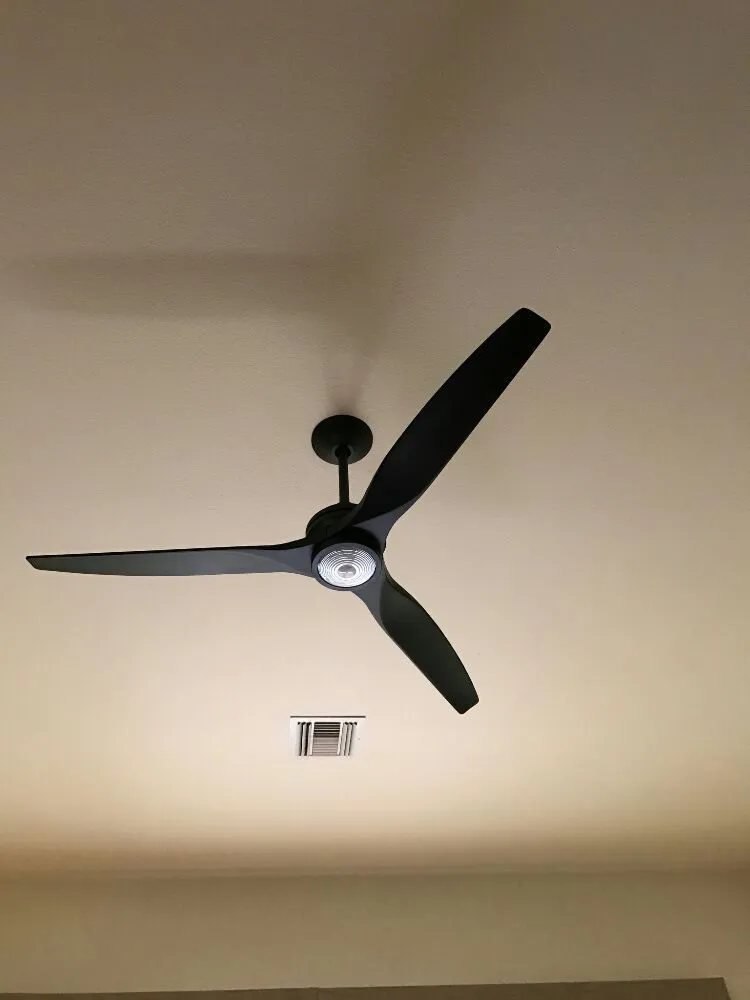
In Aiea, a well-placed ceiling fan lets you feel cooler at a warmer thermostat setting, which stretches the trade winds and trims your cooling bill. The details that matter here are ceiling height and the right downrod, a wet-rated fan for a lanai, and a real fan-rated box that can carry the weight and the motion. Done right, one afternoon of work pays you back every hot month.
Aiea sits up off the water between Halawa and Pearlridge, with Aiea Heights climbing into the hills above. When the trade winds are blowing, a lot of homes here can stay comfortable with almost no air conditioning at all. The trick is moving that air through the house and across your skin, and nothing does that as cheaply as a ceiling fan. A fan does not lower the room temperature. What it does is move air over you so sweat evaporates faster, and that makes a room feel several degrees cooler than the thermostat reads.
I am Jerry, and my sons and I have hung fans in every kind of Aiea home, from the older plantation-era houses down near Kamehameha Highway to the mid-century tract homes up in Newtown and the newer places in the Heights. Here is what actually goes into a fan install that works with our climate instead of fighting it.
Why a fan beats running the AC harder
On Oahu we pay some of the highest electricity rates in the country, so anything that lets you back off the air conditioning is money in your pocket. A ceiling fan pulls a fraction of the power an AC unit does. When you run a fan and nudge the thermostat up a few degrees, you feel the same comfort while the compressor runs far less. In a house that already gets good trade-wind flow, the fan is often all you need on most days, and the AC becomes the backup for the still, muggy stretches when the winds die down.
The other quiet benefit is humidity. Aiea air is damp, and moving air helps keep that dampness from settling into rooms and closets. A fan on a low setting all day keeps the air turning over, which discourages the mustiness that still, humid rooms collect.
Ceiling height and the downrod question
The single most common mistake we fix is a fan hung too close to a tall ceiling. Plenty of Aiea homes, especially the newer ones and the remodels, have vaulted or nine and ten foot ceilings. A fan flush against a high ceiling barely moves the air where you actually are, down at seat and bed level. For real airflow, the blades want to sit roughly eight to nine feet off the floor. That means a downrod sized to your ceiling, longer for the tall rooms and vaulted spaces.
Sloped and vaulted ceilings need a sloped-ceiling adapter along with the right downrod so the fan hangs level and true. We measure the ceiling, figure the drop, and set the fan at the height that actually cools the room rather than the height that looks tidy against the ceiling. It is a small detail that decides whether the fan does its job.
Wet-rated fans for the lanai
The lanai is where Aiea living happens, and it is also where the wrong fan dies fast. A covered lanai is exposed to humidity, wind-driven rain, and the salt-laden air that drifts up from Pearl Harbor and the coast. An indoor fan out there will rust, seize, and warp its blades within a couple of seasons.
Fans carry a rating for exactly this. A damp-rated fan is built for covered, protected spots that see humidity but not direct rain. A wet-rated fan is sealed and finished to take direct water and the harsh coastal air head-on. For most Aiea lanais we go wet-rated to be safe, because our trade-wind rain blows sideways under a lot of overhangs. The blades, the housing, and the hardware on a wet-rated fan are made to hold up, and that is what keeps you from replacing it in two years.
The box is the part you do not see
Here is the part that separates a safe install from a hazard. A ceiling fan is heavy, and it spins, so it puts constant load and vibration on whatever holds it up. A standard light-fixture box is not built for that. Hanging a fan off a light box is how you end up with a wobbling fan, cracked ceiling material, and in the worst cases a fan that pulls loose.
A fan needs a fan-rated box that is secured to the framing, either mounted directly to a joist or carried on a fan brace rated for the weight. When we replace an existing light with a fan, swapping in a proper fan box is a standard part of the job. On a room with no existing ceiling box, we run the circuit, cut in, and mount a fan-rated box that can carry the fan for the life of the house. You should never assume the box already up there is rated for a fan, because most of the time it is not.
Controls, wiring, and getting it quiet
A fan install is also a wiring job. Older Aiea homes often have a single switch loop that ran a light, and adding a fan can mean pulling a new conductor so you can control the fan and the light separately. We can set you up with a wall control for speed and light, or a remote, whichever fits how you use the room. A properly balanced, correctly wired fan runs quiet. If your current fan hums, ticks, or wobbles, that is almost always a mounting, balance, or wiring issue we can put right.
Where a fan goes over a bed or a sink, or out on a lanai, we make sure the circuit protection matches code for the location. Details like that are why a permitted, licensed install is worth it over a quick DIY hang that leaves you with a fan you do not trust running while you sleep.
Where fans make the biggest difference
- Bedrooms, so you can sleep at a warmer setting with the AC off on breezy nights.
- Living and family rooms with vaulted ceilings, where the right downrod finally moves the air.
- Covered lanais, with a wet-rated fan built for the coastal air.
- Kitchens and dining areas that trap heat and cooking humidity.
- Older homes upgrading from a single ceiling light to a fan with separate light control.
Cool the smart way
We install ceiling fans across Aiea, Halawa, Pearlridge, Newtown, and up into Aiea Heights, and we handle the box, the downrod, the wiring, and the controls so the fan is safe and it actually cools. See our gallery for past work, learn more on our ceiling fan installation page, or get in touch and call (808) 342-8195 for a free quote.
Frequently Asked Questions
Can I put a ceiling fan on my lanai?
Yes, as long as it is the right fan. A covered lanai needs at least a damp-rated fan, and for most Aiea homes we recommend a wet-rated fan because our trade-wind rain blows sideways under overhangs and the coastal air is hard on hardware. An indoor fan out there will rust and seize within a season or two. We match the rating to how exposed your lanai actually is.
My ceiling is really high. Will a fan even help?
It will, but only with the correct downrod. A fan mounted flush to a nine or ten foot ceiling barely moves air where you sit. We size a downrod so the blades land around eight to nine feet off the floor, and we use a sloped-ceiling adapter on vaulted rooms so the fan hangs level. That height is what actually cools you.
Do I need a special electrical box for a ceiling fan?
Yes. A fan is heavy and it vibrates, so it needs a fan-rated box secured to the framing or a rated fan brace. A standard light box is not built for that load and can lead to a wobbling fan, cracked ceiling, or worse. Swapping in a proper fan box is part of every install we do, and you should not assume the box already up there is rated for a fan.
Can you add a fan where there is only a light now?
Yes. We replace the light box with a fan-rated box and, if needed, pull an extra conductor so you can control the fan and the light separately from the wall or a remote. In many older Aiea homes the original switch only ran a light, so this small wiring change is common and it makes the fan far more useful.
Will a fan really lower my electric bill?
Indirectly, yes. A fan does not cool the room, it cools you, so you can raise the thermostat a few degrees and feel the same comfort while the AC runs much less. On Oahu rates, running a low-wattage fan instead of a hard-working compressor adds up fast, especially on breezy days when the fan alone keeps you comfortable.
Why does my current fan wobble or hum?
Almost always it is mounting, balance, or wiring. A fan hung on the wrong box, out of balance, or on a marginal circuit will wobble, tick, or hum. We can rebalance it, move it to a proper fan-rated box, and correct the wiring so it runs quiet, or replace it if the unit itself is worn out.
Need a licensed Aiea electrician?
Jerry and the team at Sparky & Sons LLC handle it all, from a single fan to a full panel. No job is too small. Honest pricing, clean work, island-wide.
Call (808) 342-8195Request Service